 how-to
How to Track Keto Macros Correctly: A 2026 Guide
Table of Contents
- What Keto Macros Are and Why Tracking Matters
- Calculate Your Personalized Keto Macro Targets
- Using a Keto Macro Calculator to Set Daily Targets
- Tracking Net Carbs on Keto: Total vs. Net Carbs Explained
- Your Daily Macro Tracking Workflow
- Keto Macros for Weight Loss: Protein, Fat, and Calorie Deficit
- How to Adjust Keto Macros When Progress Stalls
- Common Mistakes in Macro Tracking and How to Avoid Them
- Frequently Asked Questions
Last Updated: October 11, 2026
What Keto Macros Are and Why Tracking Matters
Keto macros are the amounts of fat, protein, and carbohydrates you eat each day on a ketogenic diet, and learning how to track keto macros correctly is the foundation of success on this eating plan.
The ketogenic diet shifts your body into ketosis, where it burns fat for fuel instead of carbohydrates (Ketogenic Diet: A Review of Composition Diversity, Mechanism of Action and Clinical...). This only happens when you keep carbs low and maintain the right macro balance.
Macronutrients are the three types of food your body uses for energy: fat (9 calories/gram), protein (4 calories/gram), and carbs (4 calories/gram). On keto, you'll eat mostly fat, moderate protein, and very few carbs, with the exact breakdown depending on your individual goals.
Calculate Your Personalized Keto Macro Targets
Your keto macro targets depend on your weight, activity level, and goals. A sedentary office worker needs different targets than someone who exercises five days a week.
Finding Your Calorie Baseline
Start by determining your Total Daily Energy Expenditure (TDEE), your resting metabolism plus calories burned through activity.
Multiply your body weight in pounds by 14 to 16 for a rough maintenance estimate. A 200-pound person needs roughly 2,800-3,200 calories daily to maintain weight.
For weight loss, aim for 500 calories below maintenance, which typically results in losing about one pound per week (Rate of weight loss can be predicted by patient characteristics and intervention...). If your maintenance is 3,000 calories, target 2,500 per day.
Determining Fat, Protein, and Carbohydrate Percentages
The typical keto macro split is 70-75% fat, 20-25% protein, and 5-10% carbs, though this is a starting point, not a rule.
Here's how to calculate your personalized targets using your calorie baseline:
Fat targets: Multiply your daily calories by 0.70 (for 70%), then divide by 9 (calories per gram of fat). If you eat 2,500 calories, that's 2,500 × 0.70 = 1,750 calories from fat. Divided by 9 = about 194 grams of fat per day.
Protein targets: Multiply your daily calories by 0.25 (for 25%), then divide by 4 (calories per gram of protein). Using the same example: 2,500 × 0.25 = 625 calories from protein.
Carbohydrate targets: Multiply your daily calories by 0.05 (for 5%), then divide by 4. Using the example: 2,500 × 0.05 = 125 calories from carbs. Divided by 4 = about 31 grams of carbs per day.
Most beginners set a carb limit first (usually 20-50 grams daily) and adjust fat and protein accordingly. A lower carb limit means faster ketosis entry.
Using a Keto Macro Calculator to Set Daily Targets
A keto macro calculator saves time and reduces errors by automatically generating your personalized targets.
Most calculators ask for age, sex, weight, height, activity level, and goal. The calculator outputs your daily calorie target and grams of fat, protein, and carbs, often with macro percentages for quick reference.
Calculators provide consistency and let you adjust variables to see how changes affect your macros.
Tracking Net Carbs on Keto: Total vs. Net Carbs Explained
This is where many people get confused. When you log food, you'll see two carb numbers: total carbs and net carbs. Understanding the difference is critical.
Total carbs are all carbohydrates in a food. Net carbs are total carbs minus fiber and sugar alcohols, which your body can't digest and don't affect blood sugar or ketosis.
One cup of broccoli has 6 grams of total carbs but only 2 grams of net carbs. On keto, you count the 2 grams, which is why you can eat more vegetables than expected.
Most keto practitioners track net carbs, not total carbs. Your daily carb target of 20-50 grams is a net carb target.
Your Daily Macro Tracking Workflow
Tracking keto macros correctly means following a consistent process every single day. This workflow keeps you on target and makes adjustments easier when you need them.
Weighing Food and Reading Nutrition Labels
Accuracy starts with weighing your food. Eyeballing portions leads to underestimating calories and overestimating protein, small differences add up over a week.
Buy an inexpensive digital kitchen scale (under $20). Weigh everything for the first month to develop better portion intuition.
Weigh food and write down the exact amount. Look up nutrition information on packaged labels or online databases. Enter the exact weight you measured.
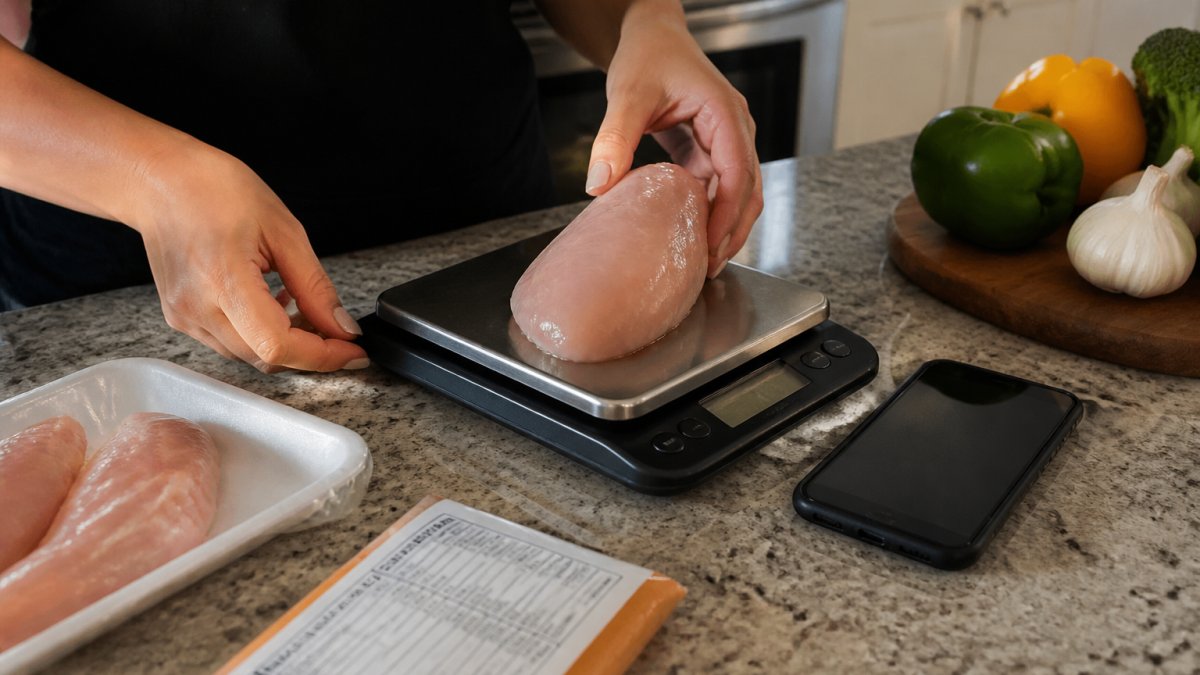
The nutrition label shows macros per serving, but the serving size may not match your weight.
Most food tracking apps do this math automatically, making them easier than manual tracking.
Logging Meals and Tracking Daily Totals
Log every meal as you eat it. Real-time logging keeps you accountable and lets you adjust if you've already hit 80% of your daily carbs by lunch.
Most tracking apps work the same way: search for the food, select the correct item, enter the amount you weighed, and hit add. The app adds the macros to your daily total automatically.
At the end of each day, review whether you stayed under your carb target, hit your protein target, and stayed around your calorie target. Being within 5-10% is fine; consistency matters more than perfection.
Handling Restaurant Meals and Inaccurate Food Entries
For restaurant meals, estimate conservatively. Assume more oil and butter than home-cooked versions. If a burger is claimed at 600 calories, log it as 700-750 to protect against accidental overeating.
Look up restaurant nutrition information online before you go to remove guesswork.
Food database entries can be wrong. If an entry looks suspicious, search for the same food from a different source and compare entries.
When in doubt, overestimate. It's better to underestimate your progress than to overestimate your intake and wonder why you're not losing weight.
Keto Macros for Weight Loss: Protein, Fat, and Calorie Deficit
Weight loss requires a calorie deficit. Keto makes this easier because fat and protein are more satiating than carbs, you feel fuller on fewer calories.
Protein is the most important macro for weight loss because it preserves muscle during a deficit.
Aim for at least 0.8 grams of protein per pound of your goal body weight.
Fat is flexible, eat enough to feel satisfied without hitting a specific target. Adjust based on hunger and energy levels.
Carbs stay low, usually 20-50 grams per day. This keeps you in ketosis and makes staying in a calorie deficit easier.
The calorie deficit drives weight loss. If you're not losing weight after three weeks, reduce your calorie target by 100-200 calories.
How to Adjust Keto Macros When Progress Stalls
After a few weeks or months, progress may slow as your body adapts. This is normal.
Recognizing When to Change Your Targets
Weight loss isn't linear, water weight and hormonal fluctuation cause variation, not failure.
If the scale hasn't moved in four weeks with accurate tracking, adjust your approach.
Try one change at a time: reduce calories by 100-200, increase activity, reduce carbs further, or increase protein slightly. Give each change two weeks before trying another.
Electrolytes, Fiber, and Micronutrients Beyond Macros
Tracking macros is important, but fatigue, headaches, or muscle cramps often point to electrolyte imbalances, not macro problems.
Sodium, potassium, and magnesium are electrolytes your body needs. Fewer carbs mean less water retention and more electrolyte loss, causing keto flu.
Add salt to your food, drink bone broth, eat potassium-rich foods like avocados and spinach, and consider a magnesium supplement.
Aim for 25-35 grams of fiber daily from vegetables, nuts, and seeds for digestive health (Dietary recommendations for dietary fibre intake).
Eat a variety of vegetables, nuts, and fatty fish for micronutrients, or consider a multivitamin if concerned about gaps.
Common Mistakes in Macro Tracking and How to Avoid Them
Most people make the same mistakes when they start to track keto macros. Knowing what to avoid saves you weeks of frustration.
Mistake 1: Trusting memory instead of logging immediately. Log as you eat.
Mistake 2: Rounding down portions. Log exact amounts.
Mistake 3: Ignoring hidden carbs. One tablespoon of ketchup has 4 grams of carbs; two tablespoons of peanut butter has 7. Log everything.
Mistake 4: Eating too little protein. Protein preserves muscle and satiates.
Mistake 5: Not adjusting for activity. Recalculate targets every few months.
Mistake 6: Comparing to others. Calculate your own targets.
Mistake 7: Expecting perfection. Aim for consistency, not 100% accuracy.
| Mistake | Why It Matters | How to Fix It |
|---|---|---|
| Not logging immediately | You forget details and underestimate intake | Log meals as you eat them |
| Rounding portions down | Small errors compound into big ones | Use exact weights from your scale |
| Ignoring hidden carbs | Sauces and condiments add up quickly | Log everything, including oils and seasonings |
| Eating too little protein | You lose muscle during weight loss | Aim for 0.8g per pound of goal weight |
| Not adjusting for activity | Your needs change over time | Recalculate targets every 8-12 weeks |
| Comparing to others | Everyone's body is different | Use your own data to guide adjustments |
| Expecting perfection | You burn out and quit | Aim for consistency, not 100% accuracy |
Tracking keto macros correctly is how you move from hoping keto works to knowing it works.
At Hyper-Ketosis 101, our comprehensive 60-day bundle options include planning and tracking tools to help you start and stay consistent on your nutritional journey.
Frequently Asked Questions
What are net carbs, and how should I track them on keto?
Net carbs are total carbohydrates minus fiber and sugar alcohols. On keto, you track net carbs because fiber doesn't spike blood sugar or disrupt ketosis. To calculate: subtract grams of fiber (and sugar alcohols if present) from total carbohydrates. Most keto dieters aim for 20-50 grams of net carbs daily. When logging meals, check the nutrition label for both total carbs and fiber, then calculate the difference. This distinction is critical because ignoring it can push you out of ketosis.
How do I calculate my keto macros using a macro calculator?
A keto macro calculator requires your weight, height, age, activity level, and weight loss goal. The calculator determines your daily calorie needs, then splits them into macro percentages: typically 70-75% fat, 20-25% protein, and 5-10% carbohydrates. Convert these percentages to grams (fat and protein = 4 calories per gram; carbs = 4 calories per gram). For example, if your target is 2,000 calories with 75% fat, that's 1,500 calories from fat, or roughly 167 grams daily. Most calculators do this automatically, showing your personalized targets in grams per day.
How often should I adjust my keto macro targets?
Adjust your keto macros every 4-6 weeks if progress stalls or every 10-15 pounds of weight loss. When adjusting, recalculate your calorie deficit based on your new weight, as your metabolic needs change as you lose weight. If you're not losing weight after 3-4 weeks, reduce calories by 5-10% or increase protein slightly to preserve lean body mass. Track your energy levels and hunger alongside the scale; if you feel fatigued or constantly hungry, your deficit may be too aggressive. Consistency matters more than perfection, so avoid changing targets too frequently.
Can I follow lazy keto without tracking macros?
Lazy keto focuses on keeping carbs low without tracking fat and protein. While some people lose weight this way, precise macro tracking can help ensure you're in a calorie deficit and eating enough protein for lean body mass. Lazy keto works best if you're already close to your target weight or have significant weight to lose. However, if you've hit a plateau or want consistent results, switching to full macro tracking can support your progress.