 ultimate-guide
Getting Started With Keto 2026: A Beginner's Guide
Table of Contents
- Getting Started With Keto in 2026: What's Different This Time
- How Many Carbs on Keto? Setting Your Daily Limit
- Your Keto Foods List for Beginners: What to Buy and What to Skip
- A Simple Keto Meal Plan for Beginners: Your First 7 Days
- Keto Flu Symptoms and Remedies: How to Push Through Week One
- Why Most People Quit Keto by Week Three (And How to Stay Consistent)
- Conclusion: Your First 60 Days Start With One Decision
- Frequently Asked Questions
Last Updated: October 9, 2026
Getting Started With Keto in 2026: What's Different This Time
The keto diet is not new, but the way people approach it in 2026 has changed.
Hyper-Ketosis 101 provides a simple, structured approach to low-carb living through digital guides, cookbooks, and planning tools, helping users start and stay consistent on their nutritional journey.
Here is what most guides get wrong: they treat keto as a 30-day sprint. The people who succeed treat it as a skill they build over 60 days or more.
How Many Carbs on Keto? Setting Your Daily Limit
Most people need to stay under 20-50 grams of total carbs per day to reach and maintain ketosis. The exact number depends on your activity level, metabolic health, and how long you have been low-carb.
Here is how to think about it:
- 20g net carbs or less: The standard starting point. Almost everyone reaches ketosis here.
- 20-50g net carbs: Works for active people and those already fat-adapted.
- 50g+ net carbs: Unlikely to keep most people in ketosis, though highly trained athletes may tolerate more.
Net carbs are total carbohydrates minus fiber and, in some counting methods, minus half of sugar alcohols. Fiber does not spike blood glucose the way starch and sugar do, which is why it is subtracted.
A common mistake is counting "net carbs" on processed keto-labeled products and eating far more of them than intended.
For anyone tracking closely, the 2026 approach is to pair carb counting with a continuous glucose monitor for the first two weeks.
CDC nutrition and healthy eating guidance
Your Keto Foods List for Beginners: What to Buy and What to Skip
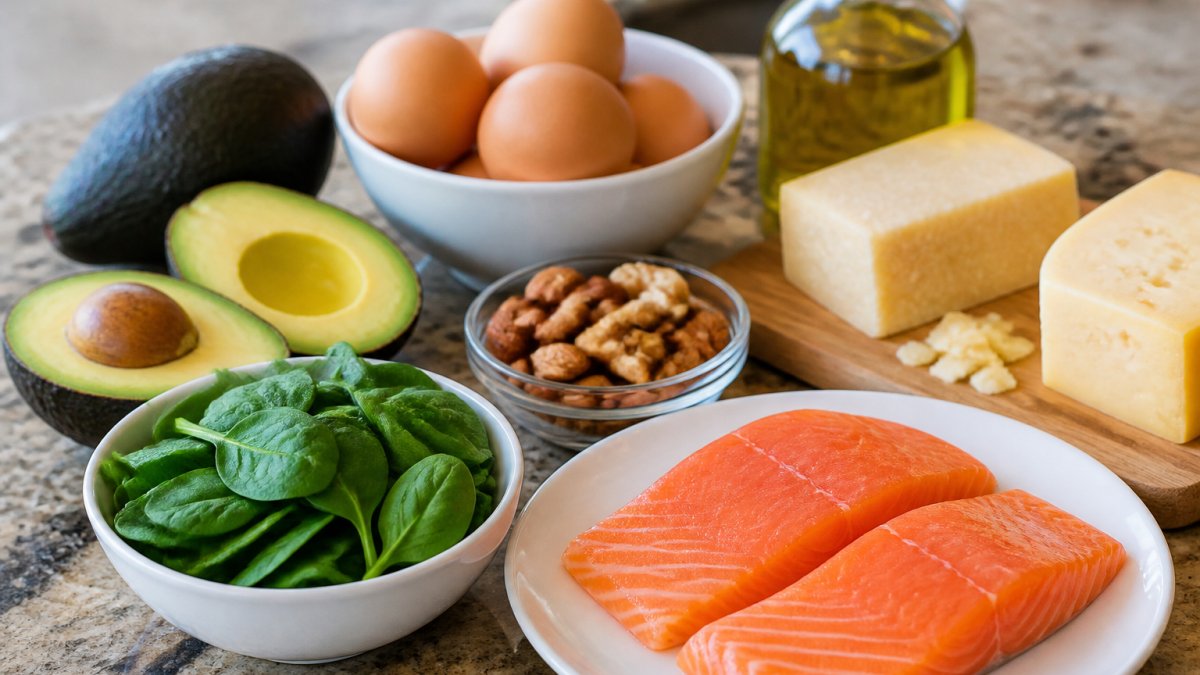
A keto foods list for beginners comes down to one rule: build meals around protein, fat, and non-starchy vegetables, then add carbs last.
Eat freely:
- Eggs, beef, poultry, pork, lamb
- Salmon, sardines, mackerel, tuna
- Butter, olive oil, coconut oil, ghee
- Avocado, spinach, kale, broccoli, cauliflower, zucchini
- Cheese, Greek yogurt in moderation, heavy cream
- Nuts and seeds: almonds, walnuts, pecans, chia, flax
Eat in small amounts:
- Berries (raspberries, blackberries)
- Tomatoes, onions, peppers
- Dark chocolate above 85%
Skip entirely:
- Bread, pasta, rice, oats, most cereals
- Sugar, honey, maple syrup, most fruit juices
- Beans, lentils, most legumes
- Potatoes, sweet potatoes, corn, peas
- Most processed "low-fat" products, which are usually high in sugar
The distinction between "clean keto" and "dirty keto" matters here. Clean keto emphasizes whole foods and quality fats. Dirty keto allows processed meats, artificial sweeteners, and fast food as long as the macros fit.
| Category | Best Choices | Avoid |
|---|---|---|
| Protein | Eggs, salmon, beef, chicken thighs | Breaded meats, processed deli slices |
| Fat | Olive oil, butter, avocado | Margarine, seed oil blends |
| Vegetables | Spinach, cauliflower, zucchini | Potatoes, corn, peas |
| Snacks | Nuts, cheese, olives | Keto-labeled cookies, candy bars |
A Simple Keto Meal Plan for Beginners: Your First 7 Days
A keto meal plan for beginners should repeat meals. Variety is the enemy of week one, because every new recipe is a new decision, and decision fatigue is what breaks most people.
The five core meals:
- Eggs and bacon with spinach, 3 eggs, 3 slices bacon, 1 cup sautéed spinach. Roughly 2g net carbs, 30g protein, 35g fat.
- Chicken salad with olive oil and avocado, 6oz chicken thigh, 1/2 avocado, 2 cups mixed greens, 2 tbsp olive oil. Roughly 5g net carbs, 40g protein, 35g fat.
- Ribeye with buttered broccoli, 8oz ribeye, 2 cups broccoli, 2 tbsp butter. Roughly 6g net carbs, 50g protein, 45g fat.
- Salmon with asparagus and hollandaise, 6oz salmon, 1 cup asparagus, 2 tbsp hollandaise. Roughly 4g net carbs, 35g protein, 40g fat.
- Ground beef with cauliflower rice and cheese, 6oz 80/20 ground beef, 1.5 cups cauliflower rice, 1oz cheddar. Roughly 5g net carbs, 40g protein, 40g fat.
Your 7-day rotation:
- Day 1: Meal 1; Meal 2; Meal 3
- Day 2: Meal 1; Meal 4; Meal 5
- Day 3: Meal 1; Meal 3 (leftover ribeye sliced over greens); Meal 5
- Day 4: Meal 1; Meal 2; Meal 4
- Day 5: Meal 1; Meal 5; Meal 3
- Day 6: Meal 1; Meal 4; Meal 2
- Day 7: Meal 1; Meal 3; Meal 5
Notice there are no snacks built in. Most beginners eat too often out of habit, not hunger.
The 2026 upgrade: track your glucose response, not just your macros.
A continuous glucose monitor (CGM) changes how you use a meal plan. Instead of assuming a meal works because the macros fit, you watch your own blood glucose response in real time.
If you do not have a CGM, a blood ketone meter is the next best tool.
USDA dietary guidelines and nutrition resources
Keto Flu Symptoms and Remedies: How to Push Through Week One
Keto flu symptoms and remedies are the most-searched topic for new keto dieters, and for good reason. The transition week is uncomfortable for many people.
Common keto flu symptoms include headache, fatigue, brain fog, muscle cramps, dizziness, and irritability. They typically appear on days two through five and fade within a week.
The cause is not carbohydrate withdrawal in the way people assume. It is primarily electrolyte loss.
Fixes that actually work:
- Salt your food generously. Add a pinch of salt to your water.
- Drink bone broth or salted bouillon once or twice daily.
- Take magnesium glycinate in the evening for cramps and sleep.
- Eat potassium-rich foods: avocado, spinach, salmon, mushrooms.
- Drink water when thirsty, but do not force excessive amounts, which dilutes electrolytes further.
What most guides miss is that keto flu is largely preventable. If you start salting your food properly on day one, many people skip the worst of it entirely.
Why Most People Quit Keto by Week Three (And How to Stay Consistent)
Week three is where the wheels come off. The novelty is gone, the scale has often stalled, and social situations start piling up.
The three patterns that explain most quits:
- The scale plateau. Water weight drops fast in week one, then stops. Fat loss continues but more slowly. People misread this as failure. A common pattern is a 5-8 pound drop in week one, then 1-2 pounds per week after, which is still excellent progress, but feels like nothing compared to the first week.
- Social friction. Restaurants, family dinners, and office snacks make strict keto feel antisocial. The person who white-knuckles through a birthday party without eating cake often binges the next day, not because they were hungry, but because they felt deprived.
- All-or-nothing thinking. One slice of birthday cake becomes "I already ruined it," and the whole week collapses. This is the single most common psychological trap in keto, and it is almost never addressed in beginner guides.
The fix is not discipline. It is a pre-decided plan for the moments you know will come.
Decide in advance what you will order at your three most frequent restaurants.
The 2026 angle: address the emotional trigger, not just the carb count.
Most keto guides treat overeating as a math problem. It is not.
A practical approach: keep a simple log for two weeks. Not of food, of how you felt before you ate.
What sustainable keto actually looks like past week three:
- You stop counting every gram and start eating the same 10-15 meals on rotation.
- You accept that some days you will be at 30g carbs, not 20g, and that is fine.
- You stop using the scale as your only metric and start tracking energy, sleep, and how your clothes fit.
- You plan for the social events instead of avoiding them.
This is also the point where many people benefit from structure.
NIH resources on weight management and metabolic health
Conclusion: Your First 60 Days Start With One Decision
The hard part of keto is not the science. It is the consistency. Most people know what to eat. Far fewer have a system that carries them past week three, through plateaus, and into a sustainable pattern.
If you are ready to stop guessing, Hyper-Ketosis 101 gives you the structured 60-day plan, cookbooks, and tracking tools to make low-carb living simple.
Frequently Asked Questions
What is the best way for a beginner to start a keto diet?
Start by cutting net carbs to 20-30 grams per day and building meals around protein, healthy fats, and low-carb vegetables. Don't try to overhaul everything at once. Pick three or four simple meals you enjoy, eat those on repeat for the first week, and track your carbs loosely. Once you're past the keto flu window, you can expand your recipe rotation. A structured 60-day plan removes the guesswork and keeps you from quitting at the first plateau.
How many carbs should a beginner eat on keto?
Most beginners do well at 20-30 grams of net carbs daily. Net carbs are total carbs minus fiber and sugar alcohols. This range reliably pushes most people into ketosis within one to two weeks. If you're active or have a higher metabolic flexibility, you might stay in ketosis at 40-50 grams, but start low and adjust upward once you know how your body responds. Tracking for the first few weeks helps you learn portion sizes and hidden carb sources.
What are common side effects when starting keto?
The most common early side effects are headache, fatigue, brain fog, muscle cramps, and irritability, often called keto flu. These usually hit between days two and five and fade within a week. They're driven largely by electrolyte loss as your body sheds water and glycogen. Adding sodium, potassium, and magnesium to your daily routine, plus drinking more water, prevents most of these symptoms. If symptoms persist beyond two weeks, review your carb intake and hydration.
How can you tell whether you are in ketosis?
Early signs include reduced appetite, clearer mental focus, and a metallic taste in your mouth. More reliable indicators are blood ketone meters or breath ketone analyzers, which give real-time readings. Urine strips work for the first week or two but become less accurate as your body adapts. If you're hitting your carb target and eating moderate protein, you're likely in ketosis within one to two weeks even without testing.
What foods can you eat on a keto diet?
Focus on meat, poultry, fish, eggs, full-fat dairy, avocado, olive oil, butter, nuts, seeds, and low-carb vegetables like spinach, zucchini, broccoli, and cauliflower. Berries in small amounts are usually fine. The key is keeping net carbs low while getting enough protein to preserve muscle and enough fat to feel satisfied. A keto foods list for beginners helps you shop without second-guessing every label.
How long will it take to lose 20 lbs on keto?
Many people lose 5-10 lbs in the first two weeks, mostly water weight. After that, fat loss typically runs 1-2 lbs per week for those with a moderate calorie deficit. Reaching 20 lbs often takes six to twelve weeks, depending on starting weight, activity, sleep, and how strictly you stick to your carb limit. The scale will stall some weeks even when fat loss continues, so track measurements and energy levels alongside weight.
Getting started with keto in 2026 is easier than it has ever been, but easy access to information has not made consistency easier. The difference between people who succeed and people who quit is almost never knowledge. It is structure. Hyper-Ketosis 101 was built for exactly that gap, with a 60-day bundle, integrated planning tools, and cookbooks that remove daily decision fatigue. If you are tired of starting over, get started with Hyper-Ketosis 101 and build the routine that finally sticks.